|
December 8, 2003
Biotechnology is being starved of the opportunity to show its
real worth, according to WA scientists gathered at an address by
the Swiss developer of golden rice, Professor Ingo Potrykus,
during 10th anniversary celebrations at the Murdoch
University-based Western Australian
State Agricultural
Biotechnology Centre (SABC).
|
Professor Potrykus developed golden rice as a humanitarian
project to deliver vitamin A to people in developing countries,
where rice is the staple diet. Vitamin A deficiency is believed
to be responsible for 3000 deaths per day and 500,000 cases of
infant blindness per year.
“Although the necessary biotechnologies were discovered in the
1980s and golden rice was finalised by 1999, the crop has still
not made it to farmers in developing nations that need it
because of regulatory obstacles based on undue paranoia.
“The cost in human life resulting from the prevention of its use
far exceeds any hypothetical or imagined risks associated with
genetically modified organisms (GMOs),” Professor Potrykus told
the assembled scientists.
“Regulators are unable to cope with the concept of a new variety
in which a metabolic pathway has been deliberately added, and so
they have prevented even controlled planting of small scale
field plots to generate enough seed for further testing,”
Professor Potrykus said.
|
|
 |
|
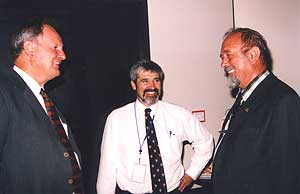
(left to right) SABC Chairman, Hendy Cowan of Narembeen and
Director, Professor Mike Jones meet with golden rice
developer, Professor Ingo Potrykus before his presentation
at the SABC’s 10th anniversary celebrations at
Murdoch University. |
SABC Director, Professor Mike Jones said over-regulation also
stymied the technology in Australia where local research has
yielded tremendous advances in crop development only to be
shelved because the release of GMOs was not feasible in the
current political climate.
“SABC based company, Grain Biotech Australia, for example, is
developing salt tolerant wheat varieties which could open up one
million hectares of saline WA land to profitable crop
production,” Professor Jones explained.
“That could have tremendous social ramifications in rural Western
Australia by
returning industry to marginal areas and bolstering WA’s wheat
harvest by more than 25 per cent. The new wheat promises to
remove salt from the soil to help ameliorate salinity, while
delivering a profit to growers.”
Professor Jones said that while most of the biotechnological
research conducted at the SABC was not transgenic, it was this
field that delivered the novel results and made otherwise
impossible advances viable, as was the case overseas with
Professor Potrykus’ golden rice.
An expert panel of biochemists assembled by the Rockefeller
Foundation in 1991 had rated the chances of developing golden
rice (containing provitamin A) at less than 0.5 per cent, but
nonetheless supported the project for its humanitarian
potential.
Professor Potrykus adopted transgenic technologies because
provitamin A was not present in any of the 80,000 known rice
accessions, and so the pathway for its production had to be
introduced into rice. Within nine years, he and his team had
developed rice plants of which 200 grams per day is believed
sufficient to deliver the necessary vitamin A requirements of
people in developing nations.
Regulation must be scaled back to reasonable scientific levels
to help recognise the potential of such GM crops, according to
Professor Potrykus, who said everyone knew the regulations were
wrong, but were afraid to say so for fear of criticism.
“Should those who oppose GM technologies for political advantage
or self-interest be held responsible for the unnecessary
suffering of millions of people with vitamin A deficiency who
would benefit from golden rice?”
Although efforts were underway to augment golden rice with
higher iron and protein levels, Professor Potrykus had been told
that there was no chance of regulators clearing such a crop for
release. The global death toll due to dietary deficiencies of
vitamin A, magnesium, protein and iron is 24,000 per day or 8.76
million per year. |


