|
February 7, 2003
Chua lab discovers protein that
regulates early growth arrest
An infant plant sleeps
peacefully within its seed, entirely shielded from drought
and other harsh conditions that might otherwise threaten its
well-being. When the time comes at last to wake up
and stretch its budding leaves, the young seedling must do
so very carefully; once it decides to enter the
unpredictable world outside, there's no turning back to the
safe haven of the seed.
Yet, growing up may not be
quite as risky for a young plant as scientists once
believed. According to
Rockefeller University research, newborn plants have a
second chance to hold off on growth after breaking through
their seed coats. |
 |
|
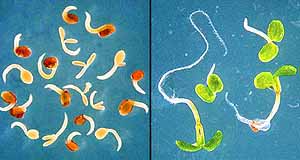
In the presence of the plant hormone ABA, young Arabidopsis plants will hold off on growth until outside conditions become favorable (top). Mutant plants overproducing the newly identified AFP protein, on the other hand, lack this developmental arrest and blossom without delay (bottom). These and other experiments indicate that AFP helps to restore growth in normal plants by terminating the developmental arrest.
|
This developmental arrest,
or checkpoint, offers protection against the possibility that a
plant accidentally sprouts or "germinates" when conditions are
poor, for example in times of drought.
"A cool summer rain might fool a winter plant into germinating
too early, when there's not enough water
in the soil," says Nam-Hai Chua, Ph.D., head of the Laboratory
of Plant Molecular Biology at Rockefeller. "This growth arrest
would give that plant the chance to salvage its mistake by
essentially
freezing growth for up to 30 days."
The findings may have applications in the food biotechnology
industry, because they suggest new
genetic strategies for creating drought-resistant crops.
Now, new research from the Chua lab, reported in the Feb. 1
issue of Genes & Development, identifies a novel protein in the
experimental plant Arabidopsis that helps terminate this
developmental arrest,
thereby indirectly reinitiating growth. Like a police officer
restoring the flow of traffic by removing a barricade, this
protein, called AFP, re-establishes growth by eliminating the
primary protein, called
ABI5, in charge of executing the arrest.
"Previously, we had determined that ABI5 is essential for this
early growth arrest to occur," says Luis
Lopez-Molina, Ph.D., first co-author of the paper and, until
last September, a postdoctoral fellow at
Rockefeller. "Now, we have identified AFP as contributing to the
removal of ABI5.
"In other words, ABI5 triggers the delay and AFP helps terminate
it," says Lopez-Molina.
In the United States and all over the world, drought
increasingly plagues farmlands, resulting in decreased food
productivity. By better understanding how plants naturally
tolerate drought and other
environmental stressors, Chua and colleagues hope to genetically
enhance this ability in crop plants.
In addition, the latest research may lead to improvements in
methods for seed storage. In every bag of
stored seeds, a certain percentage goes to waste because some
seeds prematurely germinate and begin to grow — a costly loss
for poor, developing countries. Because the Rockefeller
scientists now know the identity of two of the molecular wardens
in charge of this developmental delay, it may be possible to
genetically control when plants initiate growth, and save a lot
of otherwise squandered seeds.
Other scientists involved in this research include co-author and
equal contributor S颡stien Mongrand,
Ph.D., another former postdoctoral associate at Rockefeller who
is now at Centre National de la R飨
erche Scientifique/ Université Bordeaux 2, France; and Natsuko
Kinoshita, a former guest student at
Rockefeller now studying at City University of New York (CUNY).
Lopez-Molina has joined the
faculty of CUNY, where he is starting his own plant biology
laboratory.
A pause before blossoming
 |
The Rockefeller researchers
first uncovered this novel developmental arrest in 2001
while studying
abscisic acid (ABA), the primary plant hormone responsible
for safeguarding both newborn and
adult plants against environmental stress. In newborns, ABA
blocks premature growth; in adults, it actively regulates a
plant's response to stress, for example by closing a plant's
pores in times of drought to prevent the "sweating out" of
much-needed water.
At the time, scientists
believed that ABA's specific job in newborns was to stall
germination until conditions became ripe for growth.
|
|
L-R: Nam-Hai Chua, Sébastien Mongrand and Luis Lopez-Molina
|
But the Rockefeller team changed
this notion when they discovered that the hormone was in fact
better at keeping young plants in an arrested state of
development for up to 30 days — after they had left the comfort
of their seeds.
Further exploring this early growth arrest, the researchers hit
upon the key protein behind it, called
ABI5. They showed that for ABA to be able to pause growth, ABI5
must be present.
"We found that mutant plants lacking ABI5 could not arrest
growth in response to drought and
subsequently died, whereas normal plants survived under the same
conditions," says Lopez-Molina.
Together, these experiments suggest that ABA, through the
activity of ABI5, gives newborn plants a
second opportunity to hold off on growth until auspicious
conditions arise.
Devious partner
In the new Genes & Development paper, the story continues to
unfold with the discovery of AFP, a
novel ABI5-interacting protein. After the scientists had
characterized the role of ABI5 in the
developmental arrest, they set out to find proteins that
regulate ABI5. Using a technique called the
"yeast two-hybrid screen," they fished out a novel
protein-binding partner of ABI5, and later named it
AFP for "ABI five-binding protein."
The researchers then discovered that when they presented a newly
germinated plant with high amounts of ABA, AFP levels rose in
tandem with those of ABI5. In addition, mutant plants lacking
AFP showed abnormally high ABI5 protein levels, resulting in
hypersensitivity to ABA. This provided evidence that AFP
negatively regulates ABI5 in normal plants. Further studies with
enzymes called "proteasome inhibitors" indicated that AFP
promotes the removal of ABI5 by the proteasome; in basic terms
this means that AFP signals the cell to chop up ABI5 into little
bits.
"AFP is like a soldier that sits and waits until the right time,
then — boom — eliminates ABI5," says
Lopez-Molina, adding, "this makes sense because you have to get
rid of ABI5 somehow so the plant
will grow when favorable conditions appear."
Filling out the picture even more, the researchers showed how
AFP might target ABI5 for degradation. It turns out that AFP and
ABI5 travel to the same spots in a cell's nucleus — spots that
contain a known enzyme, called COP1, thought to promote the
chopping up of proteins. "AFP takes ABI5 by the hand and carries
it to protein-destruction factories located in the cell's
nucleus. From this moment on, the plant can resume growth," says
Mongrand.
Furthermore, the discovery that AFP is produced in tandem with
ABI5 in response to stress exclusively during a short time
window further supports the existence of a second developmental
checkpoint.
Indeed, it would seem that a newly sprouted plant unexpectedly
faced with a drought can thank ABA,
ABI5 and AFP for its survival.
The researchers acknowledge the expert help of the Rockefeller
Bio-imaging Resource Center directed by Alison North.
Founded by John D.
Rockefeller in 1901, The Rockefeller University was this
nation's first biomedical research university. Today it is
internationally renowned for research and graduate education in
the biomedical sciences, chemistry, bioinformatics and physics.
A total of 21 scientists associated with the university have
received the Nobel Prize in medicine and physiology or
chemistry, 16 Rockefeller scientists have received Lasker
Awards, have been named MacArthur Fellows and 11 have garnered
the National Medical of Science. More than a third of the
current faculty are elected members of the National Academy of
Sciences.
|
