Newark, Delaware
February 1o, 2004
The
National Science Foundation has awarded a
University of Delaware (UD)
researcher $4.2 million for genetic studies of rice, a plant
that feeds more than half of the world’s population and serves
as a model for cereal crops of great economic importance in the
United States.
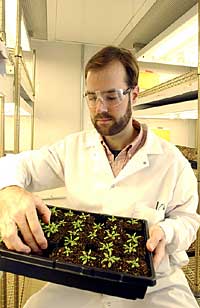 The
research is being conducted by Blake C. Meyers (photo), an
assistant professor of plant and soil sciences who is affiliated
with both the UD College of Agriculture and Natural Resources
and the Delaware Biotechnology Institute. The
research is being conducted by Blake C. Meyers (photo), an
assistant professor of plant and soil sciences who is affiliated
with both the UD College of Agriculture and Natural Resources
and the Delaware Biotechnology Institute.
The project was developed in
conjunction with co-principal investigator Guo-Liang Wang,
assistant professor in the Department of Plant Pathology at the
Ohio State University, who will generate the rice tissues and
treatments used in the analysis and assist in the analysis of
the data. Lynx Therapeutics Inc. of Hayward, Calif. will
generate data using a proprietary technology.
Meyers, who joined the UD
faculty after doing postdoctoral work at the University of
California at Davis and with the DuPont Co. at the Delaware
Technology Park in Newark, said the recent availability of the
genomic sequence facilitates functional analysis and molecular
studies of the rice genes.
However, he said, most of these
genes are as yet defined only by computational and not
experimental approaches. As a result, computational gene
predictions may not identify all RNA transcripts within the
chromosomal sequence.
Meyers said the project is
using Lynx Therapeutics’ transcriptional profiling technology
called Massively Parallel Signature Sequencing, or MPSS, to
characterize the diversity and expression patterns of rice
transcripts.
“Defining the patterns and
levels of gene expression in the rice genome will advance our
understanding of rice molecular biology and genetic factors
controlling important agronomical traits,” Meyers said.
He said this analysis of rice
has broad practical implications for the improvement of other
economically important cereals, such as corn, wheat, sorghum and
barley, because nearly all genes present in these species are
likely to have homologs, or similarities, in rice.
The MPSS data will be used to
identify genes missed by computational approaches and will
provide data that validate many genes previously predicted but
never confirmed experimentally.
Meyers said MPSS will be used
to assess gene expression under the following conditions:
- In diverse untreated rice
tissues and a subset of these tissues under cold, drought and
salt stress;
- In fungal- or
bacterial-infected rice tissues in both susceptible and
resistant plants; and
- In an Indica rice background
and in a hybrid of Indica x Japonica. This experiment will
measure differences in gene expression between the two rice
varieties for which the genomic sequence is available.
The novel transcripts
identified by the MPSS technology will be validated at the
Delaware Biotechnology Institute by microarray analysis and by
sequencing more than 500 novel transcripts, Meyers said.
All of the data�MPSS,
microarray and sequence validation of transcripts�will be made
available through a project web page.
Meyers said the web site will
include query and analysis tools to facilitate public use of the
rice MPSS data and will display the abundance and chromosomal
locations of rice MPSS signatures.
Meyers said the new NSF grant
extends his earlier work on Arabidopsis, a plant that is easy to
grow and for which the genome sequence had been determined. In
fact, the rice web site will be similar to that which has been
developed for the model plant Arabidopsis at [http://www.dbi.udel.edu/mpss].
Meyers earned a bachelor’s
degree in biology from the University of Chicago in 1992 and his
master’s and doctoral degrees in genetics from the University of
California at Davis in 1995 and 1998, respectively.
His father, Terry L. Meyers, is
on the faculty of the English department at the College of
William & Mary.
Meyers said he came to an
interest in the life sciences early in life, developing a
fascination with plants that eventually led him to this line of
research.
The NSF grant to Meyers is part
of a $100 million plant genome research project that involves 48
different institutions.
NSF is an independent federal
agency that supports fundamental research and education across
all fields of science and engineering, with an annual budget
that exceeds $5 billion. Its plant genome program examines the
structure and function of plant genes, particularly those
important to agriculture, environmental concerns, energy and
health.
According to Mary Clutter,
assistant director of NSF's Directorate for Biological Sciences,
this year's awards take advantage of the fruits of earlier
genome projects to extend existing areas of research and to
break entirely new ground.
“In key ways, these projects
will expand what we know about the biology of the plant kingdom,
including plants that have a major impact upon the lives of
people around the world,” Clutter said. “In a relatively short
time, genomics has created massive amounts of data and
innovative, adaptable tools for biological research. These now
make it possible for scientists, wherever they are, to approach
important, challenging questions in new ways.”
Article by Neil Thomas
Photo by Kathy Atkinson |


