|
Arriving in Mexico as a thirty-year-old scientist,
Norman Borlaug [...] embarked on three innovations that
formed the foundation of a wheat revolution in Mexico
and ultimately fostered the Green Revolution in Asia.
First, he painstakingly crossed thousands upon thousands
of varieties and moved forward with a few that were
rust-resistant. Next, he started a “shuttle breeding”
program that cut in half the time needed to get results
and, fortuitously, resulted in the seeds being
rust-resistant and globally adaptable. Then, he changed
the architecture of the wheat plant from gangly tall to
a short-strawed, heavy tillering structure that was
suitable for machine harvesting and was responsive to
heavy applications of fertilizer without falling over.
Yields skyrocketed.
In
reflecting on the experience, Borlaug says, “In 1944, I
resigned from a challenging research position in the
agricultural chemical division of E. I. DuPont de
Nemours & Co. to accept a position with the Rockefeller
Foundation as plant pathologist with the Cooperative
Mexican-Rockefeller Foundation Agricultural Program. I
accepted the job sight unseen, without ever having
visited Mexico, without speaking a word of Spanish.
“Many
times during the next four years, frustrated by
unavailability of machinery and equipment, without the
assistance of trained scientists, traveling over bad
roads, living in miserable hotels, eating bad food,
often sick with diarrhea and unable to communicate
because of lack of command of the language, I was
certain I had made a dreadful mistake in resigning from
my former position. However, by 1948, research results,
the bits and pieces of the wheat production puzzle,
began to emerge, and the fog of gloom and despair began
to lift. I began to see rays of sunlight and hope.”
In the
spring of 1945, after Borlaug had been in Mexico about
six months, [he was] assigned the task of organizing and
directing the Cooperative Wheat Research and Production
Program. [His] mandate was to do whatever was necessary
to increase Mexico’s wheat production. He would work
across a broad spectrum of disciplines: scientific
research in genetics, plant breeding, plant pathology,
entomology, agronomy, soil science, and cereal
technology. [...]
First Innovation: High-volume Crossbreeding
A
serious problem in Mexico that caused enormous
fluctuations in yields was epidemics of wheat rust,
Professor Stakman’s shifty enemy. Stem rust often
blasted the wheat plants before harvest and turned the
fields to sickly gray instead of a field of golden
grain. Tragically, stem rust generally was deadliest in
exactly those areas where wheat was potentially most
productive. Two other kinds of rust—brown leaf rust and
yellow stripe rust—were seldom as devastating as stem
rust.
The
native wheats were susceptible to many races of the
stem-rust organism. In three years, from 1939 to 1942,
stem rust had slashed Mexico’s national wheat harvest in
half. Losses were greatest in Sonora, the most important
wheat production region. Much of the former wheat land
had been given over to flax, cotton, and other crops,
which fared only somewhat better.
The
objective of Borlaug’s first innovation, then, was to
breed varieties of wheat that were resistant to stem
rust. His approach was to crossbreed hundreds and
hundreds of different lines in hopes of finding a few,
or even one that was resistant to prevalent rust races
and yielded well.
Most
plant breeders made only a few crosses or a few dozen
crosses each season. Each of the many individual plants
that resulted had to be observed throughout the growing
season and seeds from the “best” individuals harvested
and planted the next year, when more selections were
made, a process that was then repeated for six to seven
years. Norm couldn’t wait that long. He had to speed the
process. He collected thousands of varieties from widely
varying wheat-producing areas throughout the world. He
and his Mexican apostles began crossing them. Borlaug
says, “Crossbreeding is a hit-or-miss process. It’s time
consuming and mind-warpingly tedious. There’s only one
chance in thousands of ever finding what you want, and
actually no guarantee of success at all.”
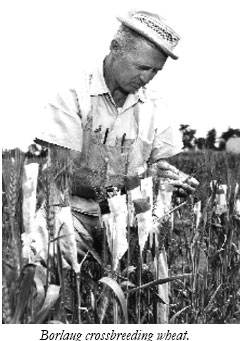 Crossbreeding
by hand is a delicate operation, performed with
surgical-type tweezers. The breeder must remove the male
stamen, which contains the immature pollen, from each
bisexual wheat flower. Otherwise, the plant will
pollinate itself. The emasculated wheat head is then
covered with a small glassine bag to prevent promiscuous
out-crossing with wind-blown pollen. After two days the
pistil (ovary) of the emasculated flower is pollinated
(fertilized) with pollen of the other parental variety. Crossbreeding
by hand is a delicate operation, performed with
surgical-type tweezers. The breeder must remove the male
stamen, which contains the immature pollen, from each
bisexual wheat flower. Otherwise, the plant will
pollinate itself. The emasculated wheat head is then
covered with a small glassine bag to prevent promiscuous
out-crossing with wind-blown pollen. After two days the
pistil (ovary) of the emasculated flower is pollinated
(fertilized) with pollen of the other parental variety.
Norm
was willing to take on the immense amount of work this
entailed. From daylight ’til sundown, he was bent over
in the experimental wheat trials, making notes and
recording differences in the varieties in resistance to
rust disease. At the time of crossbreeding, he sometimes
slept out at the field station in his sleeping bag and
cooked his food over an open campfire, in effect
reverting to his days as a forester. He went back to his
hotel in Mexico City for a bath and hot meal only
occasionally, when he could hitch a ride in the
one-vehicle fleet that the Office of Special Studies had
at that time.
The
tedious work started to pay off. It resulted in the
production of rust-resistant lines adapted to conditions
in Mexico. Yields from the improved varieties ranged
from 20 percent to more than 40 percent higher than the
yields of those they replaced. Borlaug never wasted time
searching for the perfect variety, but after adequate
testing released for commercial use the best available
at that point in time.
Second Innovation: Shuttle Breeding
Borlaug’s second breeding innovation had the initial
objective of speeding the process by growing two
successive plantings per year—one during summer in the
low-soil-fertility, rainfed areas at Chapingo and
Toluca, in high altitudes not far from Mexico City, and
another during the winter season almost two thousand
kilometers to the north, in the irrigated area near sea
level in the Yaqui Valley in Sonora, where growing
conditions and soil fertility were much more favorable.
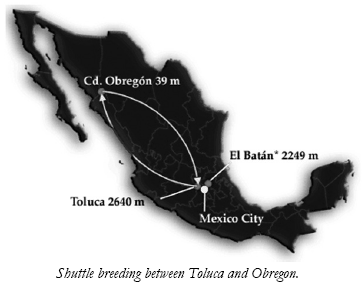 Ever
since his trip to Sonora he had been mulling over an
idea he wanted to put to the test. He had brought back
some wheat from the farms in the Yaqui Valley, and now,
in May of 1946, he wanted to prepare a plot to plant it.
If it grew well in the highlands of Chapingo or Toluca
during the summer, he would gather the seed in the fall,
take it north again, and plant it in the Yaqui. (Because
of the difference in altitude and temperature, the
Toluca and Yaqui planting seasons were at different
times of the year.) The following spring the next
generation would be harvested in the Yaqui and would be
put into the soil at Toluca, and so on back and forth.
It would mean that he could grow two generations a year
instead of one, cutting his breeding time by half. Ever
since his trip to Sonora he had been mulling over an
idea he wanted to put to the test. He had brought back
some wheat from the farms in the Yaqui Valley, and now,
in May of 1946, he wanted to prepare a plot to plant it.
If it grew well in the highlands of Chapingo or Toluca
during the summer, he would gather the seed in the fall,
take it north again, and plant it in the Yaqui. (Because
of the difference in altitude and temperature, the
Toluca and Yaqui planting seasons were at different
times of the year.) The following spring the next
generation would be harvested in the Yaqui and would be
put into the soil at Toluca, and so on back and forth.
It would mean that he could grow two generations a year
instead of one, cutting his breeding time by half.
It had
not been tried before: two generations each year instead
of one, plus a complete switch from one latitude and
altitude to another. This concept flew in the face of
traditional plant breeding methods, a dogma that
precluded two generations per year. But Borlaug saw no
genetic reason why he couldn’t grow and select two
generations each year. He would try it.
The
shuttle-breeding process yielded a double bonus. First,
as Norm had predicted, they were able to advance the
generations twice as fast. The second result, even more
important, was fortuitous. As the segregating
populations were shuttled back and forth over ten
degrees of latitude and from near sea level at the Yaqui
Valley in Sonora to over eight thousand feet of altitude
at Toluca, they were exposed to different diseases,
different soils, different climates and different
day-lengths: shortening from the time of planting in
winter in Sonora and lengthening in summer in Toluca.
The result was much more than simply a speeding of the
breeding process. The plants that survived and performed
well at both locations were now well adapted to a wide
range of conditions.
Norm
said, “The Princess of Serendip had smiled on our
unorthodox shuttle-breeding effort.” It soon became
apparent that these new early-maturing, rust-resistant
varieties were broadly adapted to many latitudes and
elevations in Mexico. Shuttle breeding subsequently
gained credence worldwide as a method that reduced by
half the years required to breed a new variety as well
as for rapidly achieving wide adaptability to a range of
variables.
Borlaug
says, “Through the use of this technique, we developed
high-yielding, day-length-insensitive varieties with a
wide range of ecologic adoption and a broad spectrum of
disease resistance—a new combination of uniquely
valuable characters in wheat varieties.”
These
characters were valuable in increasing wheat production
in Mexico and neighboring countries, including parts of
the USA, but were to prove even more valuable a decade
later when the widely adapted dwarf Mexican varieties
were successfully introduced into Pakistan, India,
Turkey, Egypt, Iran and China. Without this combination
of characters, the successful transplantation of the
Mexican varieties into other countries would have been
impossible. And the Green Revolution might never have
happened.
Third Innovation: Changing the Wheat Plant’s
Architecture
Mexico’s wheat varieties were naturally slender and
inclined to be tall. None of the varieties was capable
of efficiently using heavy applications of fertilizer to
increase yields. When fertilized they grew tall and
rank; with wind at the time of irrigation or with rain
they fell flat on the ground. Thus, more fertilizer
often meant less grain per hectare. As the use of
fertilizer increased and yields climbed to 4,500 kilos
per hectare, lodging—the tall wheat plants heavy with
grain falling over before ripening— began to limit
further increases in yields. Borlaug began a search for
wheat from different areas of the world to locate a
suitable source of genetic dwarfness to overcome this
barrier. He grew more than 20,000 lines, but found none
with short, strong stems.
 In
late 1952, Dr. Orville Vogel, a prominent US Department
of Agriculture wheat breeder stationed at Washington
State University, had obtained preliminary successes in
crossing a Japanese dwarf winter-habit wheat with his
tall US winter wheats. Vogel had obtained a sample of
the Japanese dwarf wheat seed—Norin 10—from a USDA
agricultural advisor who was serving in Japan after
World War II. The advisor had sent the seeds back to the
USDA, which distributed them to several American wheat
scientists, including Vogel, in 1948. In
late 1952, Dr. Orville Vogel, a prominent US Department
of Agriculture wheat breeder stationed at Washington
State University, had obtained preliminary successes in
crossing a Japanese dwarf winter-habit wheat with his
tall US winter wheats. Vogel had obtained a sample of
the Japanese dwarf wheat seed—Norin 10—from a USDA
agricultural advisor who was serving in Japan after
World War II. The advisor had sent the seeds back to the
USDA, which distributed them to several American wheat
scientists, including Vogel, in 1948.
When
Borlaug learned about these short-strawed wheats, he
embarked on a third major innovation. In 1953, he
obtained a few seeds from Vogel’s most successful lines
and began crossing them with the most promising, broadly
adapted Mexican varieties. A new type of wheat—short and
stiff-strawed instead of tall and slender—began to
emerge. The progeny of the Japanese short wheat tillered
profusely, thrusting up more stems from the base of the
plant than western wheats, and it had more grains per
head. A series of crosses and re-crosses gave rise to a
group of so-called dwarf Mexican wheat varieties. The
potential yield of the new varieties, under ideal
conditions, increased from the previous high of 4,500
kilos per hectare to 9,000 kilos per hectare. [...]
The
dwarf Mexican wheats were first distributed in Mexico in
1961 and the best farmers began to harvest five, six,
seven, and even eight tons per hectare. Within seven
years, the national average yields had doubled. Borlaug
named two of the best strains Sonora 64 and Lerma Rojo
64. It was these same dwarf Mexican wheats derived from
the early days of Borlaug’s transformative efforts that
would later serve as catalysts to trigger the
Green Revolution in India and Pakistan.
Borlaug’s remarkable achievement in so few years was
rare. Advances in agriculture typically are gradual. In
describing the event, Don Paarlberg, who at the time was
Director of Agricultural Economics in the office of the
Secretary, US Department of Agriculture, wrote: “Several
things about this breakthrough made it special, gave
it particular significance. It came in the hungry part
of the world, not in those countries already surfeited
with agricultural output. It came in the semi-tropics,
which had long been in agricultural torpor, not in the
temperate climates, where change was already occurring
at a pace more rapid than could readily be assimilated.
It produced new knowledge and technology that could be
used by farmers in small tracts of land, rather than
being, like many technological changes, adaptable only
on large farms. And it was a breakthrough that came
voluntarily, up from the grass roots, rather than being
imposed arbitrarily from above.”
The
Green Revolution spreads to India
In 1964
and 1965, India received five million tons of emergency
wheat grain aid each year from the United States under
the US government’s Food for Peace program. Canada and
Australia also sent grain. It was the largest food
rescue operation in history. In spite of this, the
famine worsened.
Malthusian thought—unchecked population growth always
exceeds the growth of means of subsistence—was
reawakening. Many biologists and economists were siding
with Malthus.
Concern
about the ability of the Earth to feed its people
reached a crescendo with inadequate wheat crops,
especially in India, in 1965, 1966 and 1967. Soon after
taking office, President Richard Nixon instructed his
Science Advisory Committee to study the world food
problem. The Food and Agriculture Organization of the
United Nations pushed its campaign against hunger.
The
Paddock brothers, William and Paul, published a widely
read book in 1967, Famine 1975!: America’s Decision; Who
Will Survive?, contending that famine on a vast scale
was inevitable, and counseling that efforts to avert it
be restricted to certain areas that promised some hope
of success. India was written off as beyond hope.
The
following year, Paul Ehrlich published The Population
Bomb. Writing as a biologist and environmentalist, his
book was primarily about the world’s rapidly growing
populations and the need for “population control.” But
he also made predictions about food production, which he
said could not possibly keep up with increases in human
population.
In
1967, even close associates of Norman Borlaug were not
optimistic that food production would catch up in India.
George Harrar, then president of The Rockefeller
Foundation, and the person who had headed the expert
team of Rockefeller scientists in Mexico from 1943 to
1952, said in an address in March of 1967: “It is a
fundamental fact that, next to world conflict, the
greatest single threat to mankind is that of explosive
population increase. To date, neither the disadvantaged
countries nor those who would help them have been able
to limit the vast increase in numbers.”
India
and Pakistan were contributing more than their share to
the population explosion, and had barely been meeting
their food needs by importing increasing amounts of
American wheat under the Food for Peace program.
Nonetheless, the two countries wanted to improve their
own food production rather than become permanent wards
of the United States.
This
was the climate of opinion in which Borlaug’s new
highyielding Mexican wheats began to appear in the Asian
subcontinent. The timing could not have been more
propitious. As in the past, Borlaug’s work seemed the
product of benevolent destiny. Borlaug arranged through
the Rockefeller Foundation for Dr. Glenn Anderson, wheat
expert and “gung ho leader” from the Canadian Department
of Agriculture, to join the Rockefeller Foundation staff
and help with the project in India. Dr. Ignacio Narvaez,
native Mexican and one of Borlaug’s earliest and most
talented wheat apostles, was sent to Pakistan under a
Ford Foundation grant.
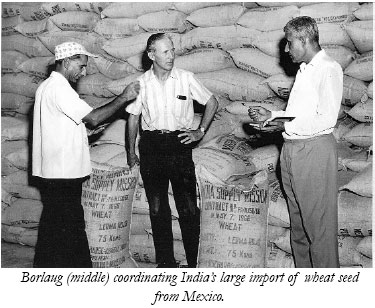 In
1964, with help from the participants Norm had trained
in Mexico, Borlaug’s wheats were planted as experiments
in various locations in both India and Pakistan. In
1965, in collaboration with local scientists and
administrative officials, Borlaug arranged for 250 tons
of seed of the Mexican dwarf wheat varieties to be
imported into Pakistan and 200 tons to be imported into
India for wide-scale testing on farms. Especially in
those settings in which Norm’s recommended cultural
practices were followed, the on-farm trials yielded
exceptionally well. In
1964, with help from the participants Norm had trained
in Mexico, Borlaug’s wheats were planted as experiments
in various locations in both India and Pakistan. In
1965, in collaboration with local scientists and
administrative officials, Borlaug arranged for 250 tons
of seed of the Mexican dwarf wheat varieties to be
imported into Pakistan and 200 tons to be imported into
India for wide-scale testing on farms. Especially in
those settings in which Norm’s recommended cultural
practices were followed, the on-farm trials yielded
exceptionally well.
India’s
Minister of Food and Agriculture, Shri C. Subramaniam,
said, “This wheat is better than anything we’ve ever
seen. We’d better go with it.”
Based
on these promising results, supplemented with equally
good results from the International Spring Wheat Yield
Nursery that had been grown at many locations in the
Near East, Borlaug concluded that it was time for strong
production campaigns in both countries. But, to be
successful, based on his experience in Mexico, he knew
that the campaigns would have to be aggressive. The
conventional wisdom at the time was that agricultural
progress in developing countries would inevitably be
slow. In 1967, the US President’s Science Advisory
Committee reported, “Since yield take-offs in the past
have required educated, alert farmers, capital, and a
commercial system of agriculture, they will be extremely
difficult to achieve in the developing nations.”
But
Norman Borlaug knew from his observations of the
euphoric reactions to field trials of farmers in
Pakistan and India that even small-scale peasant farmers
would go with the exciting new technology if given a
chance. A system was needed to provide participating
farmers with a complete package of the new technology:
the high-yielding seeds with instructions on when and
how to plant, how to fertilize it, and how to manage
weed and insect-pest control. As Norm saw it, that would
be relatively easy compared with getting changes in
government policies to make the campaigns a success.
Borlaug’s grand scheme for the campaigns was what he
called the “Kick-Off Approach,” which he based on
outright rejection of the hypothesis that agricultural
development of necessity has to be slow. His Kick-Off
Approach was founded on manipulating three
factors—technical, psychological and economic— in such a
way as to achieve rapid results. The technical factor
had already been proved to his satisfaction in the
results of the field trials. He now had to work on the
psychological and economic factors to get the required
policy changes.
Due to
drought, late sowing and poor germination, India’s
spring harvest in 1966 from approximately three thousand
hectares sown to Mexican wheat varieties, in half-acre
plots on thousands of farms, produced mixed results.
Many were good; a few were excellent. Borlaug, ever the
optimist, said, “With superb handling of supplementary
topdressing with nitrogen fertilizer and timely
application of irrigation, the seedlings tillered
profusely.” And indeed in many locations yields were
much better than any that had previously been recorded
in India. Norm said, “The Lady of Serendip had smiled
upon us, there was widespread enthusiasm, and euphoria
reigned in a few locations.”
At the
time, the drought and famine were at their worst in
northeast India, especially in Bihar and West Bengal.
Under
these dismal conditions, Minister of Food and
Agriculture Subramaniam made a courageous and historic
decision. Against the advice of several of his senior
scientists, he decided to import eighteen thousand tons
of the short-strawed, highyielding Lerma Rojo 64 seed
from Mexico.
About
the large import of seed, Norm says, “It unleashed a
flood of criticism, because of the risks involved, from
many academicians in ivory halls in affluent countries
from around the world. Shri Subramaniam and I were
charged by some critics with recklessly and
irresponsibly playing with the lives of millions of
people.”
In the
fall of 1966, approximately 240,000 hectares were
planted with seed of Mexican varieties. Before the
plantings were made, a great controversy developed, with
the economists from the Ministry of Agriculture, the
Planning Commission, and the Rockefeller Foundation,
including heavyweight David Hopper, on one side of the
issue and Borlaug and Glenn Anderson on the other.
Norm
recalls, “The economists insisted that we should cut
back the fertilizer application from 120-40-0 kilograms
per hectare of nutrients to 40-20-0 so that three times
more area and families could share the benefit of
fertilizer. We argued loudly and heatedly that this
scale-back in fertilizer recommendations was premature,
for we had not yet overcome the skepticism and
psychological barrier of the traditionalists, peasant
farmers, bureaucrats and senior scientists. At one
point, the debate became both emotional and heated. With
the diplomacy of Dr. Ralph Cummings, head of the
Rockefeller Foundation team in India, we finally calmed
down. We stood our ground and won the argument and the
heavy rate of fertilizer was applied on 240,000
hectares.” The dramatic results vindicated Borlaug and
Anderson. The Mexican seeds were the catalyst.
Fertilizer was the fuel. [...]
Borlaug
informed those present of the outstanding success of the
wheat campaign and the enthusiasm of the farmers for the
new wheats and the associated package of production
technology. He closed by saying that if the government
of India now would adopt an economic policy that would
stimulate the adoption of the new technology, it could
trigger a revolution in wheat production.
 Borlaug
indicated that government action was needed to assure Borlaug
indicated that government action was needed to assure
-
the availability of the right kind of fertilizer at
reasonable prices at the village level six weeks
before the onset of the planting season;
-
credit for the farmers to purchase fertilizer and
seed before planting, to be paid back at harvest;
and
- an
announcement before the initiation of the planting
season that, at harvest, farmers would receive a
fair price for their grain.
He said
the price should be similar to that of the international
market rather than only half that price, as had
prevailed for decades under the cheap food price
policies that had prevailed since India’s independence.
[...]
Norm
left for Mexico four hours after the meeting. Two weeks
later he received from offices of the Rockefeller and
Ford foundations in New Delhi a series of clippings
dated April 1st from all the major New Delhi newspapers.
The clippings disclosed a drastic change in policies on
fertilizer on two fronts: the government would begin to
increase fertilizer imports for the short-term and would
embark on a dynamic program to expand domestic
fertilizer production. The subsequent increases in
availability and use of fertilizer contributed to
dramatic increases in food production. |


