Western Australia
August 10, 2012
New research is beginning in Western Australia’s Kimberley region and the Northern Territory to see if rice can return as a possible mainstream broadacre crop for northern Australia.
The Department of Agriculture and Food’s Geoff Strickland said the project aimed to provide agronomic guidelines for profitable rice-based farming following three years of trial work.
“Among crops trialled in the Ord River Irrigation Area, rice has shown it can provide high returns,” Mr Strickland said. “But we need to understand a lot more about the most suitable varieties, the best establishment systems, planting dates, disease resistance and other factors to provide sound advice to commercial industry.”
The new project is supported by the Rural Industries Research and Development Corporation and will be led by department development officer Dr Siva Sivapalan (photo), based at the Frank Wise Institute of Tropical Agriculture at Kununurra.
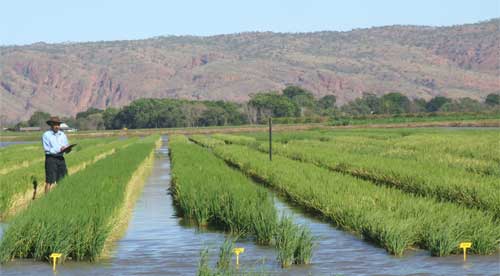
The project also involves collaborative effort with the Northern Territory Department of Resources, ORDCO, Pacific Seeds Pty Ltd, Rice Research Australia Pty Ltd, Agropraisals Pty Ltd and Department of Primary Industry NSW. Overall cost will be about three-quarters of a million dollars over three years.
Mr Strickland said rice had been grown in northern Australia in the 1960s and 1980s, including Humpty Doo in the Northern Territory, but had been abandoned as uneconomic after problems with birds and other issues.
The Department of Agriculture and Food resumed trials four years ago, and with expansion of the Ord River Irrigation Area, it was timely to assess its current potential.
He said experimental yields of up to 13.6 tonnes per hectare had been obtained in 2009, providing the highest gross margins of all trial crops in that year. This compares with about 10 tonnes per hectare on average in southern areas.
The first stage of the project will concentrate on identifying the best varieties and establishment techniques. Australian, American and Asian varieties will be compared, particularly new hybrids and those with resistance to rice blast disease.
Rice will be planted on raised beds in both the wet and dry seasons and compared with flooded and other systems. Rotating rice with other crops, such as legumes, will be explored.
Fertilisers, irrigation and weed control will be measured plus quality assessment of the harvested rice, to be done at Yanco, NSW.




 Topics
 Species