Atlanta, Georgia, USA
October 2, 2026
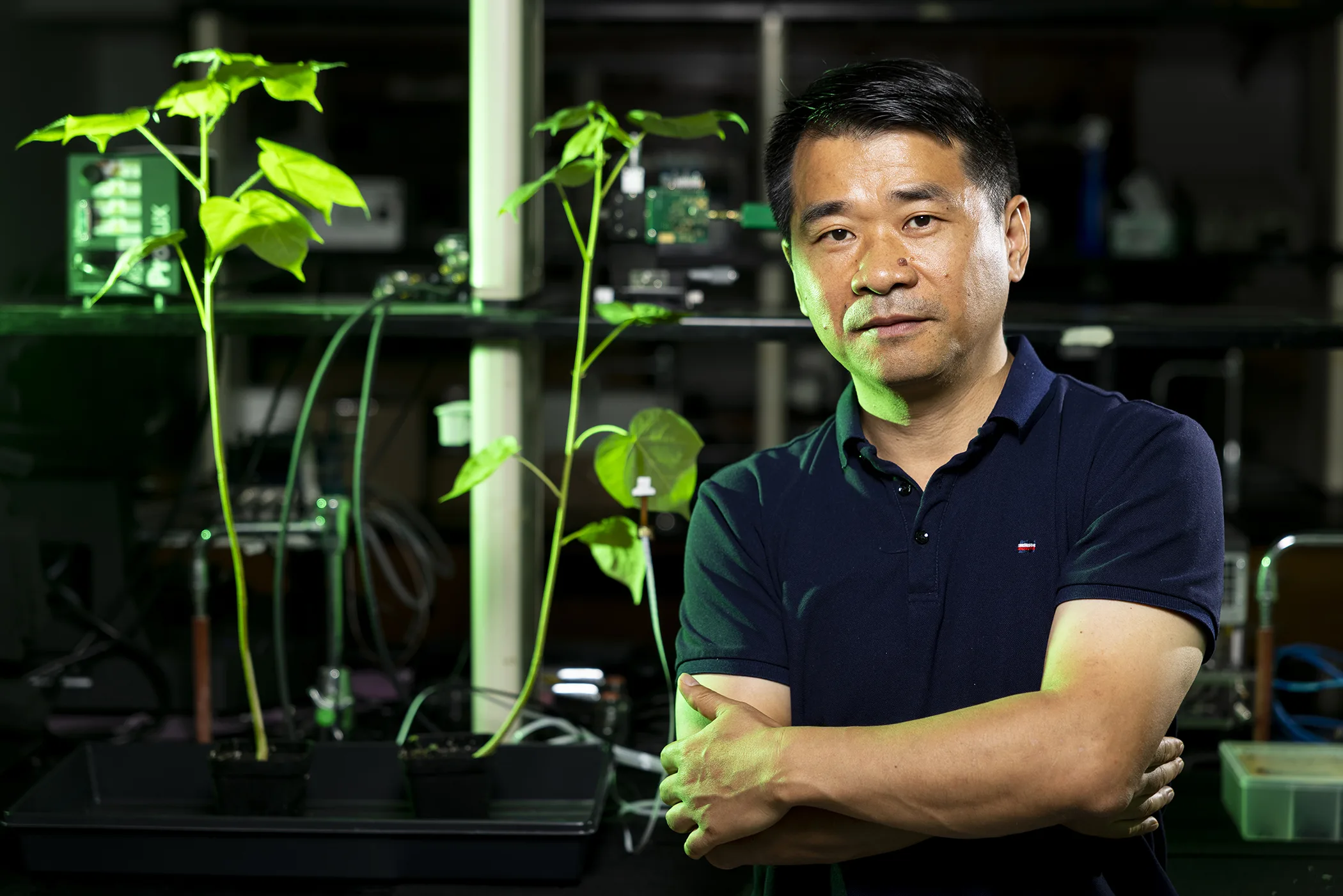 Liang Dong, Georgia Research Alliance Eminent Scholar in Precision Agriculture, is a professor with a joint appointment in the College of Agricultural and Environmental Sciences and the College of Engineering. (Photo by Billy Schuerman/UGA)
Liang Dong is advancing real-time plant health monitoring
Farmers spend a lot of time keeping a careful eye on their crops, but what you see is not always what you get, as crops can quietly begin responding to drought, disease and insect pressure long before signs of stress are visible.
At the University of Georgia, Professor Liang Dong is developing sensor technologies designed to detect those early signals, giving plants a way to communicate what they are experiencing and helping farmers make faster, more informed decisions.
As the Georgia Research Alliance Eminent Scholar in Precision Agriculture, Dong brings renowned sensor research and a passion for crop diversity to UGA, where he sees innumerable opportunities to develop sensors and precision technologies for very different agricultural systems after nearly two decades in the Midwest.
With a joint appointment in the College of Agricultural and Environmental Sciences and the College of Engineering, Dong also serves as associate director for research at the Institute for Integrative Precision Agriculture — a role he says gives him the opportunity to think at a larger scale.
“I see engineering as a natural connector. Precision agriculture requires engineering, plant and animal sciences, AI and data science, Extension, economics, and many other areas working together,” Dong said. “UGA has that breadth, and I saw an opportunity to help connect those strengths and build something bigger.”
The Georgia Research Alliance is a nonprofit, public-private partnership that invests in recruiting researchers to Georgia’s universities, enhancing labs and providing crucial seed funding and guidance to help university researchers move promising discoveries to the marketplace. Dong is UGA’s 19th current GRA Eminent Scholar.
“Transformative agricultural technologies require more than one lab or one discipline. They require teams, infrastructure and long-term partnerships. The Institute for Integrative Precision Agriculture is a wonderful hub for bringing those pieces together,” Dong said. “Along with the GRA support, it gives us a platform to attract talented students, researchers and partners and to move technologies from fundamental research toward real-world impact.”
Smart sensors give plants a voice
Dong’s research focuses on the development of novel sensor technologies for real-time monitoring of soil conditions, plant health and environmental factors, with the goal of addressing challenges in the water-energy-food-health nexus.
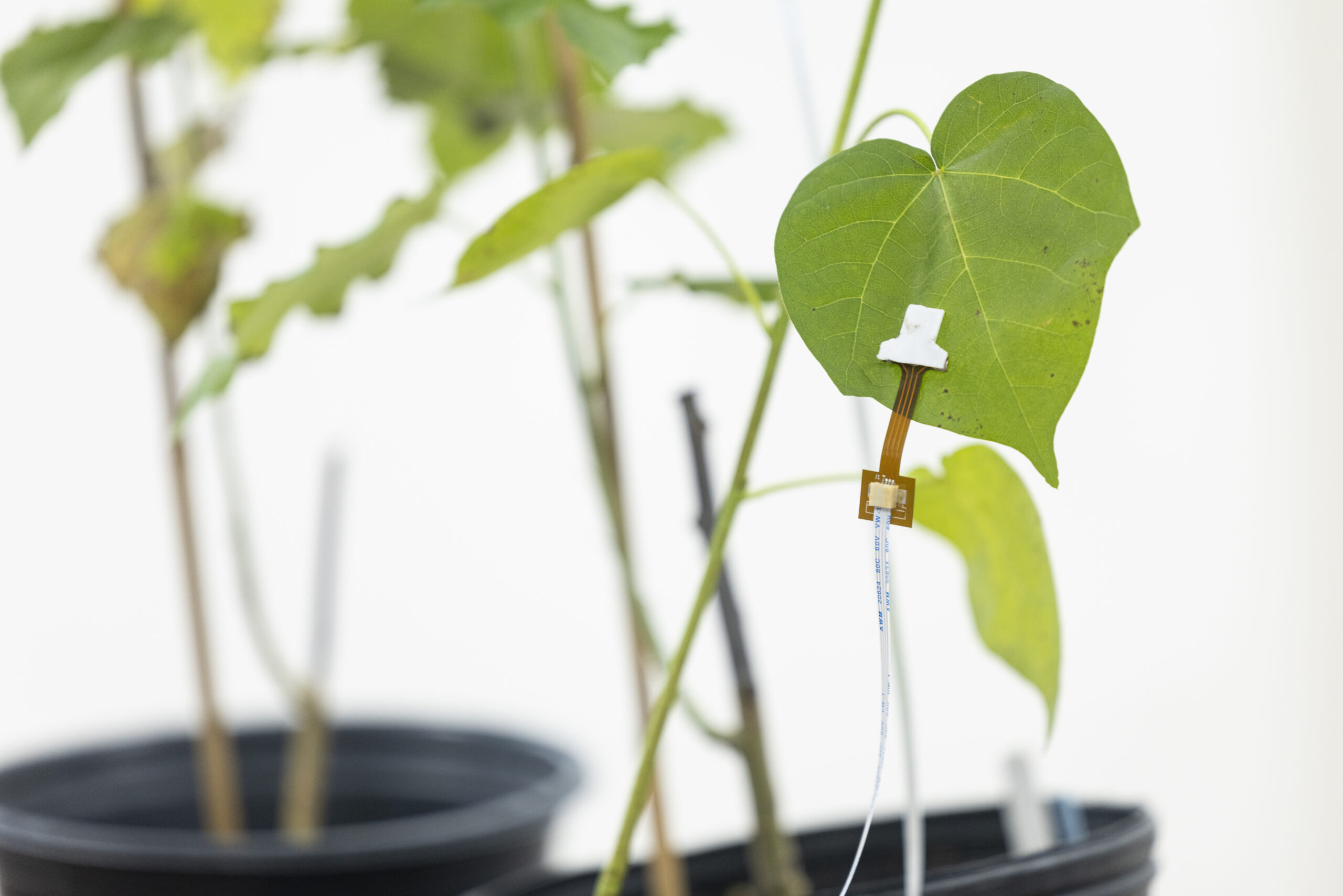
For those who haven’t spent a career in precision agriculture and engineering, Dong suggests thinking of a health tracker on a smartwatch. The device measures signals from the wearer’s body — such as heart rate — and provides the user with health data. Dong and his team are applying a similar idea to crops by designing sensors around the plant to measure the signals it produces.
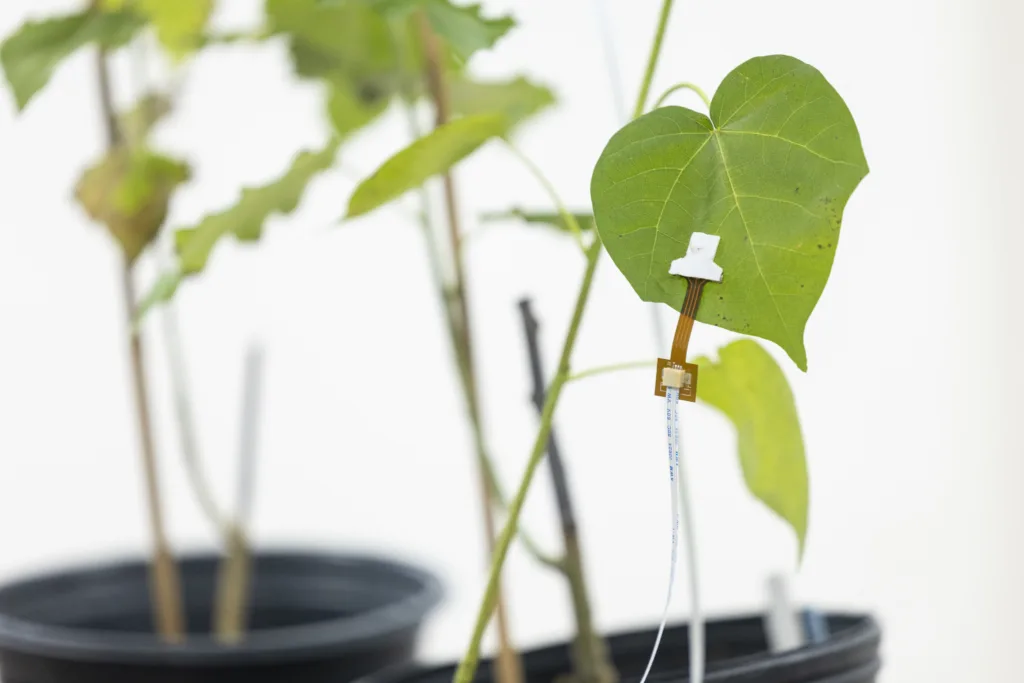 Liang Dong designed sensors for plants to detect signs of disease, insects, drought or other stressors. (Photo by Billy Schuerman/UGA)
“Instead of waiting until we can see that something is wrong, the sensor lets the plant tell us what it is experiencing,” Dong said. “In a sense, we are giving plants a voice.”
Because signs of disease, insects, drought or other stressors may not be immediately visible, the sensors Dong has developed can detect a variety of signals, including reactive oxygen species, phytohormones and volatiles, which form an interconnected signaling network that regulates plant growth, development and responses to environmental stress.
“Our sensors can also detect nutrient levels, transpiration and photosynthetic activity,” Dong said. “These signals can give us an earlier picture of what is happening inside the plant, which could be especially important for precision agriculture and crop biosecurity.”
From early detection to more efficient farm management
In Dong’s first year in the interdisciplinary role, he has spent countless hours listening to Georgia farmers, crop researchers and UGA Cooperative Extension specialists.
From these conversations, he has identified grower priorities including crop biosecurity and drought-related water management. Georgia’s drought-prone yet hot and humid climate makes addressing these issues a challenge.
“We want to know whether sensors can detect how a plant is responding to these threats before we can see visible symptoms. If we can do that, sensors could provide an early warning and help growers respond much faster,” Dong said. “More data can help growers make more precise irrigation decisions and use water more efficiently.”
Georgia’s coastal environments present different environmental pressures, including salinity.
“These different conditions make Georgia a great place to develop and test sensors that can identify multiple types of stress and help us adapt precision-agriculture technologies to different crops and production environments,” Dong added.
Looking toward the future, Dong sees sensing systems that continually tell stakeholders what is happening within agricultural systems and turn that data into practical recommendations.
In Georgia, that could mean earlier detection of crop diseases and insects, better drought and irrigation management, and new sensing technologies for poultry, livestock and forestry as well as crops.
The ultimate measure of success isn’t how many sensors his team builds, but whether those technologies help producers make better decisions, improve productivity and resilience and use water, fertilizer, pesticides and other resources more efficiently.
“Agriculture is biological, environmental, technological and economic all at the same time. An engineer can build a very sensitive sensor, but we need plant or animal scientists to tell us what signals really matter,” Dong said. “We need agricultural scientists and Extension specialists to tell us what is practical. And we need AI and data science to help turn all that information into useful decisions. That intersection is where some of the most exciting work happens.”




 Species