De Lier, The Netherlands
April 14, 2026
Babyleaf spinach has become popular due to its versatility: from salads and stir-fries to pizza toppings and smoothies. Moreover, availability is rarely an issue, because this healthy and tasty vegetable can be found in a supermarket’s chilled section all year round. Thanks in part to Rijk Zwaan’s comprehensive product range, growers can fulfil year-round delivery promises to retailers. In the meantime, behind the scenes, Rijk Zwaan’s market specialists and breeders are already working on the babyleaf spinach of tomorrow. Climate change, disease resistance and hydroponics are just some of the factors they need to consider.
Hundreds of hectares
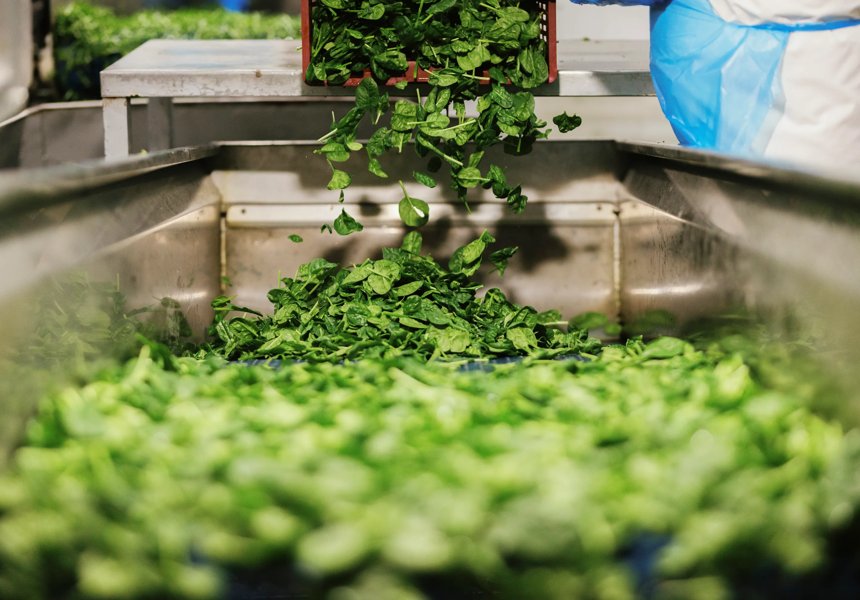
Babyleaf spinach is mechanically harvested, washed and packaged after the crop has been growing in the field for between three weeks (in summer) and 13 weeks (in winter). This leafy vegetable is grown widely in the USA – where spinach farms can span hundreds of hectares – as well as in Europe and Australia. “Some growers in northern Europe also own fields in southern Europe, and some Californian growers have locations in Yuma, Arizona. This enables them to supply their customers with fresh spinach all year round,” explains Wim in ‘t Groen, Crop Co-ordinator at Rijk Zwaan.
Year-round planning, together
To facilitate year-round production, Rijk Zwaan’s range contains roughly 75 babyleaf varieties. “We offer varieties for every market and climate zone,” Wim continues. “From fast to slow-growing varieties, we have the optimal solution available with the right mildew and disease package.”
It’s not easy for growers to choose from so many varieties. That’s why the company’s crop specialists help to create annual schedules built around a succession of spinach varieties that are perfectly aligned with the season, disease pressure, climate conditions and market situation at that time.
Breeding beyond today
In the meantime, Rijk Zwaan’s research team is working on tomorrow’s requirements, says Spinach Breeder Jan Jansen. “Breeding means looking ahead. Together with local crop specialists, we are constantly thinking about the future. What are people asking us about? What do they need?” he comments.
Based on those insights, the team works on new varieties, explains breeder David Courand: “Conducting trials at our breeding facilities in the USA, the Netherlands, Spain, Italy and Australia enables us to select varieties that suit specific climate zones. We are always looking to further improve the current offering – in terms of resistances, for example, or more resilience to climate change.”
Built to beat the extremes
Climate change definitely affects cultivation according to Jan – and he should know, because he has been a breeder at Rijk Zwaan for 40 years. “We’re seeing a shift in demand for variety types due to rising temperatures. For instance, there is less interest in fast-growing winter varieties in southern Europe, because these are increasingly being replaced by slower autumn varieties.” Besides higher temperatures, climate change is also resulting in heavy rainfall and longer periods of drought. “That’s why our breeding team is looking for robust varieties that are stronger against abiotic stress factors such as drought, heat and heavy rainfall. We’re making good progress,” he states.
Seeds you can count on
Besides influencing spinach cultivation, climate change also impacts on the production of spinach seeds. “Denmark is the prime location for seed production because of the length of the days, but in 2023 the weather there was too dry for optimal seed production, and last year it was too wet. These extreme conditions resulted in lower-quality seed being available – not only for us, but also for other seed companies. In the 32 years I’ve been working here, that has never happened before,” Wim says, worriedly. “We do everything we can to fulfil agreements with our customers but we have to disappoint people sometimes, which is annoying for all sides. We’re continuously looking for better ways to spread our risks.”
Fighting disease, together
In addition to climate resilience, resistance against diseases – first and foremost downy mildew (Peronospora effusa or Pe) – is another topic high on the breeding team’s list of priorities. “We are working on complete resistance against the 20 official Pe races in all types of babyleaf, including the new isolates that are present in the market. Moreover, we closely monitor whether new, local isolates emerge in production regions,” Jan explains. “Growers help us by sending us their diseased plants. We examine them free of charge. This enables us to give growers insight into whether it is a new isolate, and which of our varieties are resistant. Moreover, it helps us to anticipate new isolates quickly. That’s another example of how we look ahead.”
Besides downy mildew, Stemphylium (Stemphylium vesicarium or Sv) is another priority. Growers appreciate the fact that the Rijk Zwaan website lists each variety’s resistances, according to Wim: “That makes it easier for them to make the right choices in the face of disease pressure.”
Salads are changing and so is spinach
The babyleaf spinach of the future will not only be climate-resilient and disease-resistant, but will also be more diverse. The team is looking for leaves with a completely different appearance, for instance. Breeder Juliette Schot, who recently joined the team in anticipation of Jan’s upcoming retirement, explains why: “Spinach is increasingly eaten as a raw salad ingredient, including as part of 100g or 200g mixed salad bags, for example. Differently coloured and shaped leaves are a nice fit with that trend.”
Jan gives two successful examples. “We introduced Red Snapper RZ in the USA. The variety has an oakleaf shape and a red vein and stem; it’s very attractive. Another variety with a red vein is Red Tabby RZ, albeit with round leaves. Of course these are niche products, but so were lettuce types like Salanova® and Lollo rossa at the start. Now, there is a big market for them.”
Hydroponics? We’re on it
Hydroponic cultivation of babyleaf spinach is still a niche globally, but it is growing slowly but surely. In some regions, such as in the USA, Canada and Mexico, growers see it as a way to reduce their dependence on the climate. Elsewhere, such as in the Middle East, outdoor cultivation is simply not possible. Indoor cultivation of spinach on water offers an alternative. “This is not without its challenges,” Wim explains. “That’s why we conduct research to overcome them. Moreover, we have developed a special product for growers in the USA: Uni-Form hydroponic spinach. The seeds are treated to ensure excellent and simultaneous germination, and subsequent growth into highly uniform seedlings. That’s one example of how we’re helping to develop this market.”
From breeder to buyer: collaboration powers progress
Seed treatment will become even more sophisticated in the future, not least thanks to Rijk Zwaan’s new Seed Connect Centre that was opened in April 2025. The same holds true for the breeding process, in which data analysis is already helping to identify high-potential varieties more quickly. “This supplements the knowledge inside breeders’ heads,” David explains.
Lastly, Jan is keen to stress the importance of collaboration between all departments within Rijk Zwaan. “For example, pre-breeders look for markers to make it easier for us to track desired traits in genetic material. Meanwhile, to know what’s going on in the market, it’s essential to exchange knowledge with local crop specialists. Spinach growers can continue to count on the commitment of our entire company, now and in the future.”




 Topics
 Species