Western Australia
August 20, 2020
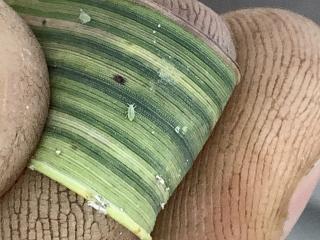
Discolouration and streaking on a wheat leaf caused by the exotic cereal pest, Russian wheat aphid. Grain growers and consultants are encouraged to report all signs of aphid damage to DPIRD via its MyPestGuide Reporter app.
Grain growers and consultants have been urged to survey cereal crops and grassy weeds for aphids and report any activity, after Russian wheat aphid was detected in two wheat crops north of Esperance.
As it is difficult to distinguish between aphid species, landholders and consultants are encouraged to report all aphid activity via the Department of Primary Industries and Regional Development’s (DPIRD) MyPestGuide Reporter app.
It is the first time the pest has been detected in Western Australia, after being discovered in South Australia in 2016 and subsequently in Victoria, parts of New South Wales and Tasmania.
DPIRD Chief Plant Biosecurity Officer, Dr Sonya Broughton, said the department has been working with industry to ensure it was well prepared in the event the pest was found in Western Australia.
“Department officers have been working with stakeholders and the broader research community across Australia over several years to minimise the impact of this pest, as it has become broadly established across Australia,” Dr Broughton said.
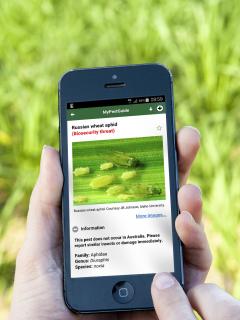
Grain growers have been urged to survey crops for signs of Russian wheat aphid and report all aphid activity via the department’s MyPestGuide Reporter app.
“A lot has been learned from the research and growers’ experiences interstate about how cereal crops respond to Russian wheat aphid and how best to manage the pest.
“Crop monitoring by landholders and delimiting surveillance by the department will help us to determine the extent of spread of the pest in WA and what actions are required.”
The National Management Group, comprising all Australian governments, Grain Producers Australia and Plant Health Australia, determined in 2016 that the pest was not technically feasible or cost-beneficial to eradicate from Australia.
Eradication in WA is unlikely due to the biology of the pest and its ability to spread on the wind.
The crops where the detection was made will be sprayed to contain the pest, while further surveillance is undertaken.
Dr Broughton said inspecting the edges of wheat, barley and oat crops, where pests often colonise first, or where plants are under stress, and looking for damage near the base of newly emerged leaves was most effective.
“Symptoms could look like herbicide, thrips, mite or wheat streak damage,” she said.
“Look for a noticeable loss of green colouration across the crop and, on closer inspection, white, yellow, purple or red streaking, leaf curling, stunted plant growth and loss of vigour.”
As Russian wheat aphids are only about two millimetres long, pale yellowish green with a fine waxy coating, a hand lens or smartphone macro lens may be useful.
Chemical permits are available to control Russian wheat aphids in grains crops, with more information available from the Australian Pesticides and Veterinary Medicines Authority's website.
More information and how to download the MyPestGuide Reporter app is available on the department’s website agric.wa.gov.au or by calling its Pest and Disease Information Service on 9368 3080 or padis@dpird.wa.gov.au.




 Topics
 Species