Würzburg, Germany
July 23, 2025
>> Neuer 3D-Laserscanner für Ernteroboter entwickelt
Robotics engineers at the University of Würzburg have developed a novel 3D laser scanner system for precise plant analysis in the field for the Leibniz Institute for Agricultural Engineering and Bioeconomy in Potsdam.
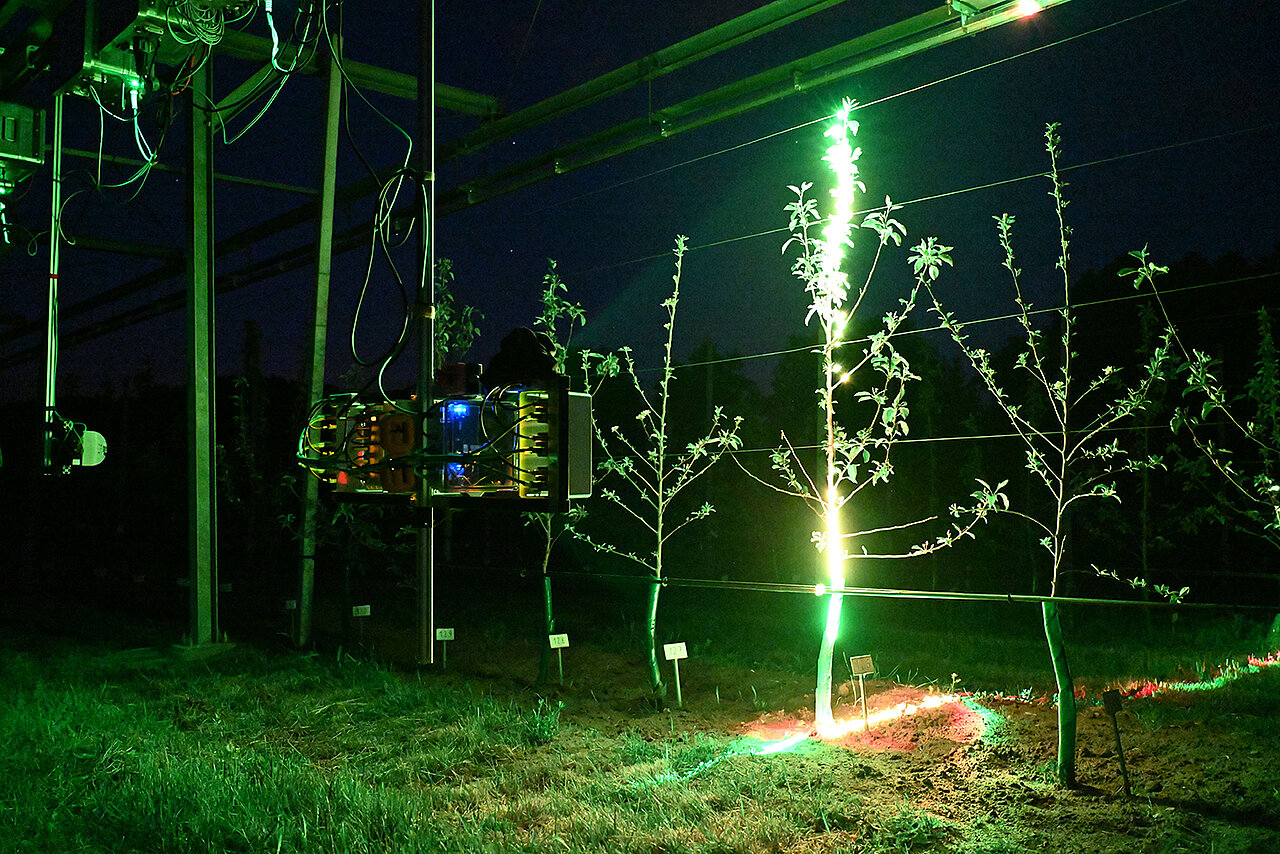
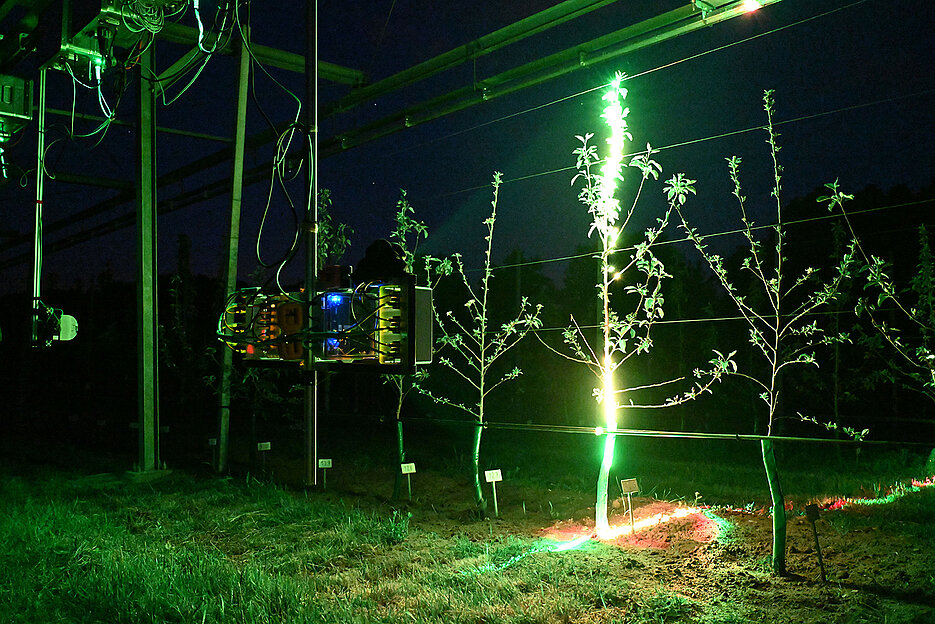 The Würzburg 3D laser scanner scans an apple tree at night. (Image: Michael Bleier / Universität Würzburg)
Whether strawberries, asparagus or apples: when it comes to harvesting, skilled workers are often in short supply. Many researchers are therefore working on harvesting robots that could provide welcome support to agricultural businesses in the future.
‘There are already a few prototypes, but none of them are really good yet,’ says robotics professor Andreas Nüchter from Julius-Maximilians-Universität (JMU) Würzburg.
Measuring How Well Plants Are Doing
To further improve the sensor technology of field robots, Andreas Nüchter's team has developed a novel 3D laser scanner system for the Leibniz Institute for Agricultural Engineering and Bioeconomy (ATB) in Potsdam. It aims to provide a better understanding of the condition of plants, for example by reliably measuring the water content of fruits – a criterion that is crucial for determining the right time to harvest.
A team led by ATB researcher Dr. Manuela Zude-Sasse has installed the system on a test site in Potsdam, and initial tests have been successful. The 3D laser scanner is mounted on a sensor conveyor station that circles around a plantation of 120 espalier apple trees.
The first tests have shown that ‘we can measure and map the plants in a meaningful way,’ says Professor Nüchter. This is important for use on harvesting robots because they must be able to ‘read’ apple trees and other plants correctly – after all, no two plants look exactly alike.
‘For the production of horticultural products, knowledge of the stage of ripeness is very important in order to be able to optimally control cultivation, harvest time and storage,’ explains Dr Zude-Sasse. ‘Against the backdrop of increasingly variable growth factors due to global warming, precise data on fruit development is becoming increasingly important – for scientific modelling as well as for the future use of commercial harvesting robots.’
Plants Are Measured Using Three Wavelengths
The new sensor system will be used continuously on the ATB test site until November 2025 to monitor the 120 apple trees. The plant scanner is designed to be robust: it can withstand wind and weather and is designed for operating temperatures between 0 and 40 degrees Celsius.
The sensor system works on the principle of structured light: It projects three wavelengths (520 nanometres, green / 660 nanometres, red / 830 nanometres, near infrared) onto the plants. The reflected signals provide precise spatial information about the plants. Because the signals are available separately for each wavelength, they open up new possibilities for recording physiological properties of the plants, such as water content.
The 3D laser scanner was designed exclusively for experimental use. It uses laser light at an intensity that can damage the human eye if looked at directly. For this reason, special care must be taken when operating the system outdoors. The ATB strictly controls access to the measurement area. This ensures that no untrained persons are in the vicinity of the scanner. The lasers pose no danger to the plants themselves.
Core Competencies of the Research Partners
The project builds on the core competencies of JMU Robotics in the development of optical devices and on the ATB's many years of crop research, where spectral-optical methods for fruit quality analysis have already been developed and comprehensive infrastructures for plant analysis under field conditions have been established. The new 3D plant scanner will be used to further improve the data basis for modelling work and the specifications for future harvesting robots.
Andreas Nüchter is a very good cooperation partner for the ATB: his group is also developing very similar methods and laser scanners for space applications. ‘Missions to the Moon or Mars always involve searching for water. In my opinion, laser scanners are particularly well suited for this,’ says the professor. The European Space Agency (ESA) has funded some of his relevant projects.




 Topics
 Species