Wageningen, The Netherlands
October 14, 2025
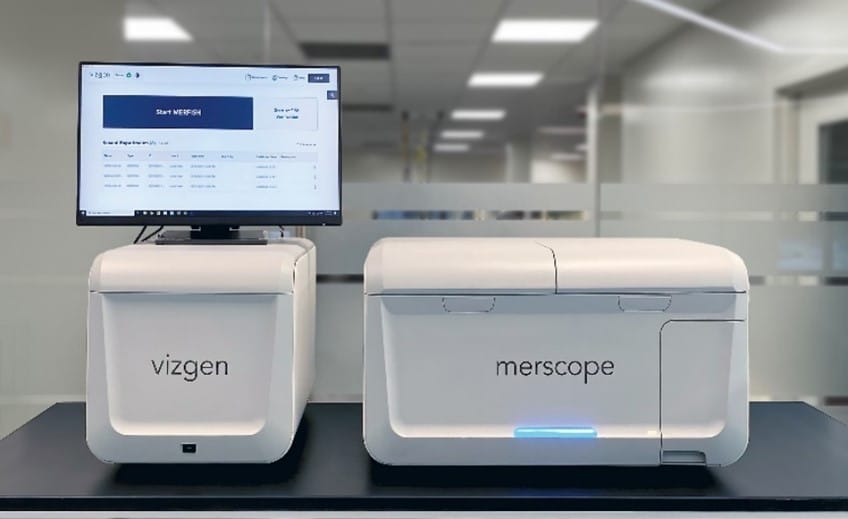
Recently, KeyGene has acquired so-called spatial transcriptomics capabilities by being the first organization in the Netherlands to purchase the Merscope platform from Vizgen.
In spatial transcriptomics, the location of gene activity within a tissue can be determined at the resolution of individual cells. KeyGene will utilize this new capability to study, among others, plant-pathogen interactions and plant development.
Studying gene activity
In conventional transcriptomics research, the increased or decreased activity of hundreds to thousands of genes is studied by determining the presence and concentration of the RNA molecules that are produced when a specific gene is active. In spatial transcriptomics, on the other hand, not only the number but also the location of RNA molecules within a tissue can be observed with very high precision. Using the Merscope, the expression of up to a thousand genes per sample can be determined with a single cell resolution in plant samples measuring up to 1×1 cm.
Innovation: cell-precision
Petra van Bergeijk, a spatial transcriptomics specialist at KeyGene in Wageningen, is enthusiastic about using spatial transcriptomics in crop research. “In spatial transcriptomics, the observed gene activity is linked to individual cells within a tissue and thus in their biologically relevant context. Using this technology, we can, for instance, observe that a certain gene is active in one cell, while the same gene is inactive in a neighboring cell.”
Fantastic pictures visualizing gene activity at cell level
“It is amazing to see gene expression pictures that have a resolution of individual cells. Using the Merscope, we were already able to observe genes that are active in plants’ stomata (leaf pores) only. These stomata regulate gas exchange between leaves and the plant’s environment. Stomata are formed by two so-called guard cells. We can now see that certain genes are active solely in these cells. In the resulting images, the guard cells are colored brightly red, indicating the presence of many RNA molecules, while the surrounding cells remain colorless” said Van Bergeijk.
 An example of spatial transcriptomics in KeyGene’s research: visualization of cell-type specific gene expression in soybean leaf tissue. Each red or green dot represents one RNA molecule from a specific active gene in an individual cell.
Crop improvement
In many crop research subjects, spatial transcriptomics opens up new possibilities for studying and understanding processes within the plant. One can think of research on the interaction between pathogens and plants where it is known that individual cells respond differently based on their distance to the infection site.
New collaborations
“These responses remain obscured when using conventional transcriptomics approaches but can now be studied in detail using spatial transcriptomics. Thus, spatial transcriptomics and the in-house Merscope will undoubtedly lead to new insights that can help advance crop breeding, here at KeyGene and together with partners, such as in our collaboration with Heinrich Heine University Düsseldorf in Germany.” said Van Bergeijk.




 Topics
 Species